Friday, February 4, 2022

Pressure to Produce


I was talking to a good friend of mine, another educator, just checking in the other day and in reflecting on our conversation I thought about how capitalism's pressure to produce over everything else ruins so much. In particular I was telling him about how so many aspects of my life involve reading and writing right now, from my day-job in education, to my PhD work as a student, and even teaching the one class that I facilitated last semester at USD, liberal studies 100. My friend said, then you must be getting really good at writing. To which I responded, maybe, but I don't feel like that right now. I feel burned out. Of course, now I'm sitting down to write about it, about how I feel burned out by how much writing I've had to do lately, and I'll process this burned out feeling, by writing about it, ha!

An idea struck me though. Within my PhD program it feels like I really want to work hard at becoming an elite athlete (an elite scholar), but instead of having room to practice our craft, instead feeling like we have space to really flourish, to move openly, and in ways that feel right for each of our bodies (minds and spirits), instead of being trusted to trust our own body (mind), intuition, and movements, it's like we're being asked to break up boulders with sledge hammers, over and over again. It's tiring. I was already tired (this pandemic has me exhausted). And so when I go to practice my own techniques, my own movements, I'm tired, burned out, feeling like the breaking down of the boulders hasn't really helped me progress in my path.

Granted, part of my burn-out, probably a large portion of it, is the COVID-blues. I am so sick of this panorama, er, I mean pomegranate, wait, wait, I meant to say pandemonium - uh, well, I think you know what I'm talking about, I hope. Or maybe I hope that you don't, because that would mean either you really don't understand what I've just written which is just fine, probably better to spare you the re-traumatization, or you're reading this from some distant place, or time - more likely time - after this has blown over and is in the annals of history.

Back to the topic, of capitalism ruining everything. My current PhD experience has some parallels with my (now) 15-year old son's high school experience, during his first semester of 9th grade. Without getting into too many intimate details, the basic gist of the connection between my experience and his is that we are struggling to help his school understand that some of their grading policies and procedures have been punitive and unrelated to our son's learning. That the compliance task-heavy nature of the industrial model of schooling is taxing, mind-numbing, soul-sucking, creativity crushing - and ultimately dehumanizing. I mean, we haven't said all of this to his teachers and school leaders, and while I think they would actually agree with some of (or even a lot of this) they, like so many educators, continue to perpetuate these cycles and systems of capitalist-driven punitive structures.

So why do we have grades? Is it to measure learning or effort? What is the definitive difference between an A and a B? Is it measurable, consistent? Is it like temperature, where a 10 degree difference in Celsius in one classroom is the same as in another? No, right? Can we be sure that the difference between two grades, the differences in assessment or evaluation of student work by a teacher, is the same between all instances of As and Bs throughout all Western forms of schooling? Of course not. An A in one class, from a particular teacher, with a particular student, is going to mean something completely different than an A in any other class, or even in the same class with a different student. So why do we keep using them as if they measure something tangible, real, or valuable - like effort and hard work? And is "effort" and "hard work" what we want to or should be measuring? 

Let me be clear, effort and hard work are keys to growth, but is that what we should be measuring in our school settings? How hard a student worked? Is it measurable? Is one student's 3 hours of focused time and effort the same as another student's 3-hours? If I can write 5 pages in less time than my brother (and I know I can), does that mean that I can get a better grade in less time with less effort? So we aren't really measuring effort then, right? Maybe these concepts of hard work and effort, that we attempt to measure, or pretend to measure, with our schooling systems' grades, are graded because they translate easiest into the capitalist working conditions that exist in our society? Maybe.


Sunday, November 3, 2019

The power of meditation and the silliness of serendipity


Today while waiting in line at Sprouts to buy my lunch I decided to be mindful - to focus on the present moment, kindly, nonjudgmentally taking note of my feelings and thoughts, and do a little walking (standing in line) meditation. As I took my first deep breath and allowed my focus to set in on my state of being I could feel anxiety rising in my belly.  I had looked over at the other line that I didn't get into and noticed that it was shorter.  I looked over again and the person I would have been behind was being rung up while I still had two people in front of me.  I heard the thought, I should have gotten into the other line. I focused on my breath and the anxiety; I noticed jealousy, jealous of the few extra minutes that my alternate-reality self would have had. Thoughts and feelings swam around, thought, I had made a mistake, I was missing out.  These feelings and thoughts were powerful reminders of how often I operate outside of the present moment.  I focused in on the present moment noticing the clerk at the register in front of me checking a $100 bill she had been given for authenticity. Then the person in front of me was being served. I stayed focused on my breath. And now I am here present with the clerk.

As I turned to leave I was looking down at my wallet and I had to stop as I almost ran into the person leaving from the other register.  It was the woman I would have been behind, the one that had gotten to the register while I was still waiting in my line.  I left her pass in front of me and a smile burst across my face. How silly of me to have worried in the first place, I had chosen the faster line (and missed out on an extra minute or two of meditation).

Friday, September 6, 2019

The perils of online education and the dopamine rabbit hole: is it 2 in the morning already?


I'm not saying I think that online education is the reason I stayed up past 2 am today.  But if I wasn't taking an online class that pointed me to a clip of the Carmichael Show, which I had never heard of, which led me to IMDB, and then Jerrod Carmichael and his stand up on YouTube, and then clips of Gaffigan and then Whose Line Is It Anyway, would I have been up until 2 am today?

Is it my lack of will power or discipline?  Or maybe the computer itself and the internet and how my brain interacts with the ideas, images, and perceived social interactions?  The muse of my amusement, the traction of my distraction.  Maybe it's the dopamine hit and the attention getting YouTube logrhythm that has me hooked?

So what can I do to limit my exposure, to hone my tool, the computer, the browser, so that I can stay focused on my academic endeavor, and get some sleep?

Use an instance of Chrome that opens with the sites I need for my class, University website, University email, blackboard (or other LMS - learning management system), and a Google drive folder with class documents.  Keep it simple, less distraction, an empty desk, a clean slate. But isn't part of the beauty and power of education and intellectual stimulation traversing rabbit holes? (Just maybe not YouTube rabbit holes?)

I mean maybe it's my ADD baby?  Really though, maybe not necessarily ADD, but I have to admit even before computers were my fix, I stayed up into the wee hours of the morning, reading, playing chess, talking with friends, or on some other inner trip.  I wonder what keeps me up like this at night? Is it any different, typing away on this draft in front of this luminous screen, than writing in a notepad? Reading this article on a tablet versus holding a physical book? I'm still not sleeping.
-----------------------------------------------------
The title of this post is misleading. I'm missing the point, or rather, I'm mixing two messages. We need to be careful how we interact with any tool, any medium. When books/novels first became popular in the 1800s there was an outcry of concern: all of these people indoors for hours reading, immobile, daydreaming, distracted from the real world work to be done.

Computers are not necessarily a problem (although my cellphone might be...damn Blogger and Blackboard apps handy on my nightstand I still haven't slept tonight at all. It's 4:33 in the am).

Learning is exhilarating. I'm enthralled, excited in the most literal sense as my intellect has been turned on and it's not turning off. I'm exuberant about the prospect of learning and growing and teaching and contributing to our body of knowledge.

My favorite quote from Professor Joi Spencer so far is, "All knowledge is political and shaped by power." So simple and so true. My father confidently and emphatically stated that teaching is political, that all action (and inaction) is political in nature as it speaks to our power and culture.  I have the beautiful opportunity within my community to facilitate the creation of new knowledge, to love each other in public, to create more social justice to transform our society together.

Monday, September 3, 2018

How often do you . . .

 rawpixel.com on Pexels

How often do you take a bite of food and masticate intentionally, slowly, deliberately?

How often do you put another bite of food in your mouth before the first bite is finished?

How often do you deliberate on what finished means? Are you done when there's no more chewing? Are you done when you swallow the last morsel? And how long do you wait before taking the next bite? How often are you present in that moment, as you swallow, feeling the food move down your esophagus while savoring the aftertaste?

How often do you lick your lips? How often are you present in the moment, focused attentively on chewing, tasting, savoring, and swallowing?

I encourage you to get a glass (or bottle) of cool (or cold) and take a big sip, and close your eyes as the water runs down your esophagus and into your stomach, and focus on the sensation of the cool liquid. In every moment there is beauty, uniqueness, a lesson. In every moment. How many lessons do we miss every minute, every hour, every day?

How often do you eat, chewing unconsciously, swallowing bite after bite, shoveling food into your mouth while your mind is on other tasks? How often do you ignore your present moment? How often do you ignore your body and its needs and its experience? How often do your mind and body act in unison?

Friday, April 27, 2018

Embrace the Eternity

https://www.pexels.com/@faaiq-ackmerd-383634
Sometimes during the first few moments of meditation I get a feeling of overwhelming eternity — this moment, these seconds, feel like they are lasting forever, as my thoughts race and my mind keeps telling me that I need to be doing other things, anything, something else other than sitting here breathing.

How long did I set my timer for? How many minutes will I be sitting here, doing nothing? If these first few seconds feel so long and unendurable, how is the rest of this meditation going to feel? Is this really the most important thing for me to be doing right now!?!

Embrace the eternity — the empty space that our mind fills with thoughts and worries. The pain that rises out of the darkness. Embrace it. As unbearably long as it may feel, this moment is fleeting. Every moment, every group of moments, will pass, eventually, inevitably.

Turn into it, lean into your discomfort. Like an empty desk, a mind with a sense of never ending time is key to creation and ideation — it is a precursor to the deep work that will lead to breakthroughs.

Embrace the space, with no phone calls, no checking of emails or statuses, no comments or likes; embrace the space where thoughts will rush in and where we can embrace and accept each thought, and clear out our cache, clear a space in our mind for deep work.

Embrace the eternity of the moment.

Friday, September 22, 2017

They're just words


(Friendly warning, profanity abound in this piece)

“They’re just words,” my father told me. I don’t remember how old I was but it stuck. My father didn’t care if I cussed — he dropped f-bombs on the regular. He didn’t do it carelessly, but it was most certainly effortless.

My dad was adamant about it too — they are words like any others, with purpose, function, and beauty. Fuck, for instance, can be a noun, “I gives no fucks,” a verb, “fuck off,” turned easily into an adjective, “That’s a fucking apple,” and used to enhance adjectives too, “That’s fucking crazy,” just to name a few of its many uses.

As a teenager I took it to the extreme, fuck being one of the most common words I used on the daily. My best friend had had enough one night and interjected in the middle of one of my fuck-infused rants. “It loses its meaning when you over use it like that. It loses its power.” I had not heard this kind of criticism before, not admonishing me for using the word itself, but for misusing it.

Fast forward to about a year ago, when my boys, at age six and nine, starting cussing in the back seat while I was driving. I thought, why not break it to them, these are just words. “Papa didn’t say anything,” one of them whispered to the other, as I was contemplating my response. “Papa did you hear what he said?” I responded that I did. “Why didn’t you tell him anything?” And so I broke it to them.

They are just words. “What do you mean Papa?” They are words like any other, with specific meanings, and nuance, with so many creative functions and uses. You simply have to know how and when to use them — the proper contexts and situations.

My boys thought this was the best news ever! They started cussing and cussing in the back seat. I explained again to them, there are proper places and situations to cuss, and improper ones. School is not a proper place. With your brother in the back seat, that might be ok with your father driving. I explained all of this, still thinking that this was somehow going to work out for my six and nine year old.

I have talked to my kids like they are adults since they were born, spoken to them without dumbing anything down, no baby-talk, no nonsense (actually lots of nonsense, nonsense is fun). Expecting my children to behave like adults based on what I told them — that was expecting too much.

It took them almost two days to figure out that in front of their mom was not the right context. The first time they dropped a bomb and their mom laid into them they said I had told them that it was okay to cuss. I had to explain to them again, and to my wife, what I had said — they’re just words, but have to be used in the proper contexts. This did not go so well with my wife, not that she didn’t agree, but she knew better than I did at the time, that our boys were not ready for this knowledge, this freedom.

My boys are still in the process of realizing the power of their words. They see that they have power, they witness the results of their words in action. Through experience hopefully they will come to understand how and why choosing their words carefully and intentionally is vital to the impact and outcomes of their interactions.

Knowledge is power. And words can be powerful too, if we use them effectively, nuanced, in the right context, with the right timing and inflection. The classic school yard saying that sticks and stones can break my bones but words will never hurt me is hogwash— baloney — poppycock (and not the sweet crunchy poppycock). Words can and do hurt — we hurt each other all of the time with what we say and how we say it.

Once you learn something, it cannot be taken away. And once you say something, most of the time you cannot take it back. You have given life to your voice and your energy, putting your ideas, thoughts, and emotions out into the world. Be careful what you say, how you say it, to whom, and in what context. Be thoughtful and intentional. Words are beautifully powerful and as with any power we can uplift and heal or we can tear down and destroy. The choice is yours.

Monday, September 18, 2017

Notifications — huh—yeah — what are they good for?

Notifications, not as serious as war, which is absolutely good for nothing, are good for something; to notify you of note-worthy things, hopefully.

I remember when my phone would incessantly take control of my attention at random moments in the middle of conversations, while I was focused on other things — interrupting my focus to notify me of responses to tweets, Facebook posts, virtual buildings being constructed, and signing monsters who needed to be tended. Was any of this by choice? Sure, I had downloaded apps and allowed their automatic notifications to remain active. Was it intentional and deliberate. Most certainly not.

We should not be subservient to our phones — it should be the other way around. Our phones should do exactly what we want them to do. I have turned off all notifications on my phone except for: texts, chats, phone calls, and my calendar app. Simple. I also put my phone away at various times of the day, when I am not willing to be interrupted by any of these functions.

I have turned off all notifications on my except for: texts, chats, phone calls, and my calendar app. Simple. I also put my phone away at various times of the day, when I am not willing to be interrupted by any of these functions.

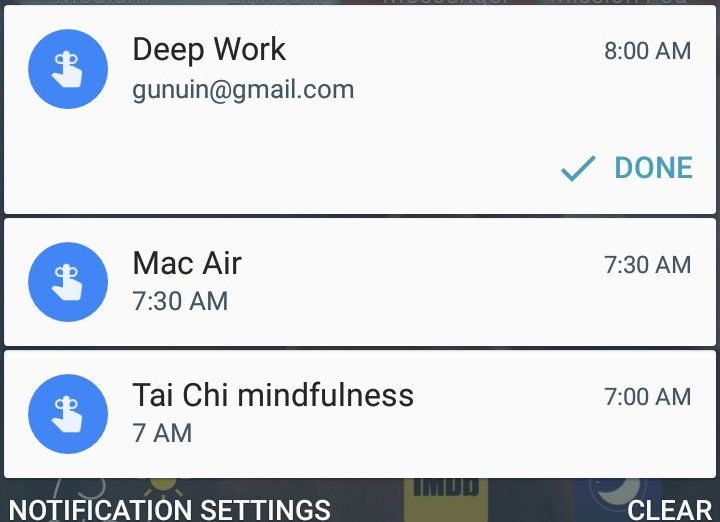
If we are going to be interrupted by our phones it should be for a good reason. It should be planned out and intentional on our part. I am using the new Google calendar “Reminder” function as a means to turn my phone into a reminding device — to remind me to meditate, journal, and complete my workouts and Tai Chi. 

If you are going to be interrupted by your phone, it should be because there is an urgent matter in your family or at work, because an old friend is looking to get a hold of you, or because you have decided that this interruption is important and is part of the intention you have for yourself for today, for your life. If your phone is interrupting you simply because you’ve installed a new app and it’s notifications are on, and this isn’t a deliberate choice on your part — I think you’ve lost control of the device. Make it intentional. Make your phone enhance your life not distract from it.